The Augsburg Confession: The Document That Defined Lutheranism
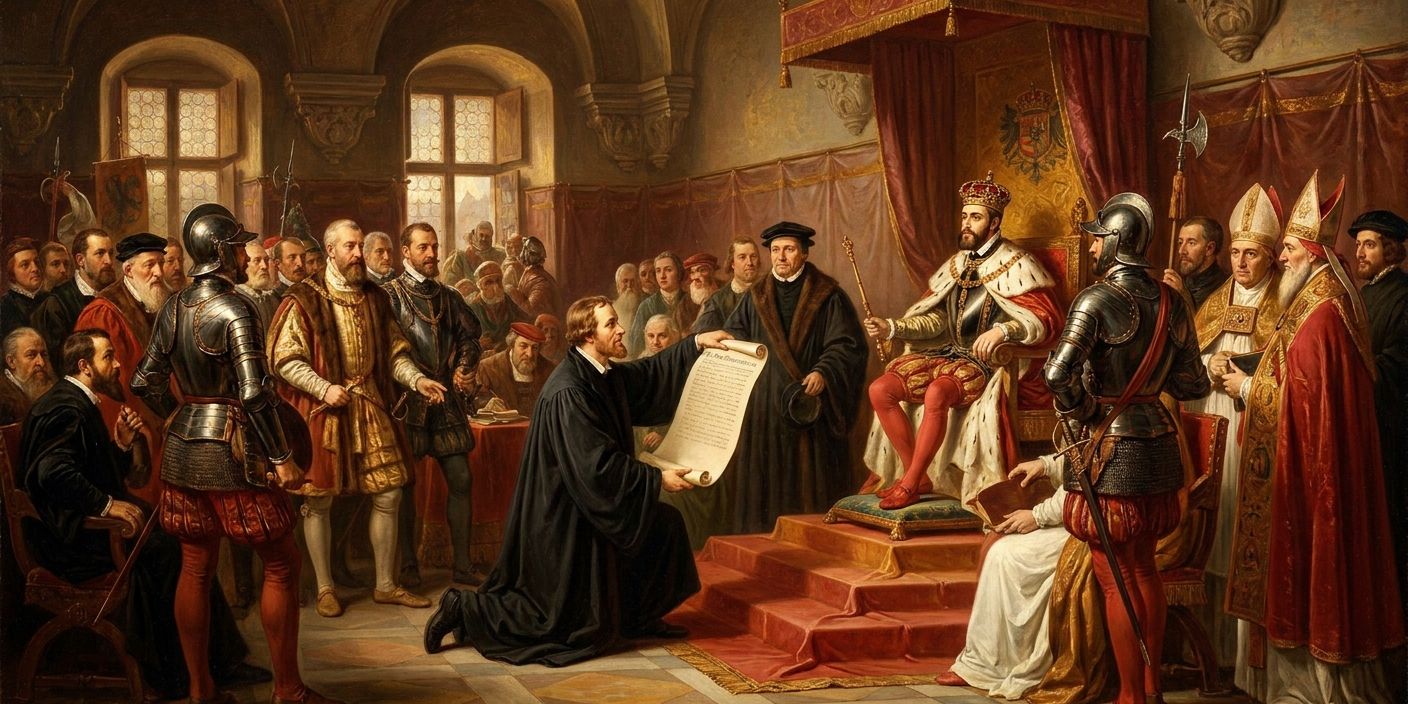
On June 25, 1530, Philip Melanchthon's Augsburg Confession was read aloud before Emperor Charles V and the assembled Diet of the Holy Roman Empire. It was a defining moment in the history of the Reformation — and in the history of the Church. Here was the Lutheran movement's formal account of its teaching, presented not as a revolution but as a return to the authentic faith of Scripture and the early Church.
Melanchthon, Not Luther
It is worth noting that Luther himself did not write the Augsburg Confession. He was under the ban of the Empire and could not appear at Augsburg. The task fell to his younger colleague Philip Melanchthon, who was in many ways better suited to it: where Luther was combative and rhetorical, Melanchthon was precise and conciliatory.
The tone of the Confession reflects this. Melanchthon was genuinely seeking agreement where it could be found, and the Confession goes out of its way to demonstrate the Lutherans' continuity with the broader Catholic tradition. It is not primarily a polemic against Rome; it is an account of what the Lutheran churches teach and why.
Structure and Content
The Augsburg Confession consists of 28 articles in two parts. The first 21 address the major doctrines of the faith: God, original sin, the Son of God, justification, the ministry, and the sacraments. The second seven address specific abuses in the existing church that the Lutherans believed needed to be corrected.
The article on justification (Article IV) is the heart of the document: "It is taught among us that we cannot obtain forgiveness of sin and righteousness before God by our own merits, works, or satisfactions, but that we receive forgiveness of sin and become righteous before God by grace, for Christ's sake, through faith."
Its Enduring Role in Lutheran Identity
The Augsburg Confession remains the primary confessional standard of Lutheran churches worldwide. To be Lutheran, in the confessional sense, is to subscribe to the Augsburg Confession. It has shaped Lutheran worship, preaching, catechesis, and ecumenism for nearly five centuries.
For all Christians, it is worth reading as a reminder of what was at stake in the Reformation: not church politics or academic disputes, but the question of how a sinner can stand righteous before a holy God.